Chunk Cards
Represent each chunk by evidence role, type, temporal anchor, scope, measurement basis, verifiability, and semantic sketch.
Financial Document Question Answering
FINCARDS turns long financial filings into structured evidence cards, then reranks candidate chunks with explicit constraints over metrics, entities, periods, and numeric evidence.
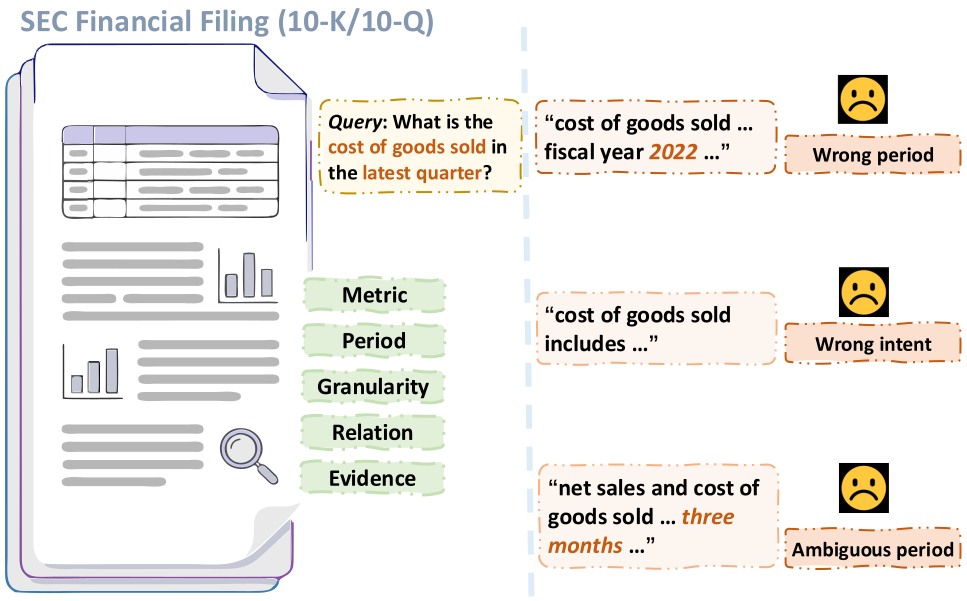
Financial question answering over corporate filings is not just semantic search. A correct evidence chunk often needs to match the requested financial metric, fiscal period, entity scope, and numeric signal at the same time.
FINCARDS reframes evidence selection as constraint-aware reranking. It exposes filing chunks as structured cards, maps questions into the same intent space, and uses tournament-style comparisons to screen, order, and stabilize candidate evidence.
The resulting rankings are easier to audit than a single monolithic long-context prompt because each decision is grounded in explicit card fields such as metrics, temporal anchors, scope, numeric evidence, table cues, and section context.
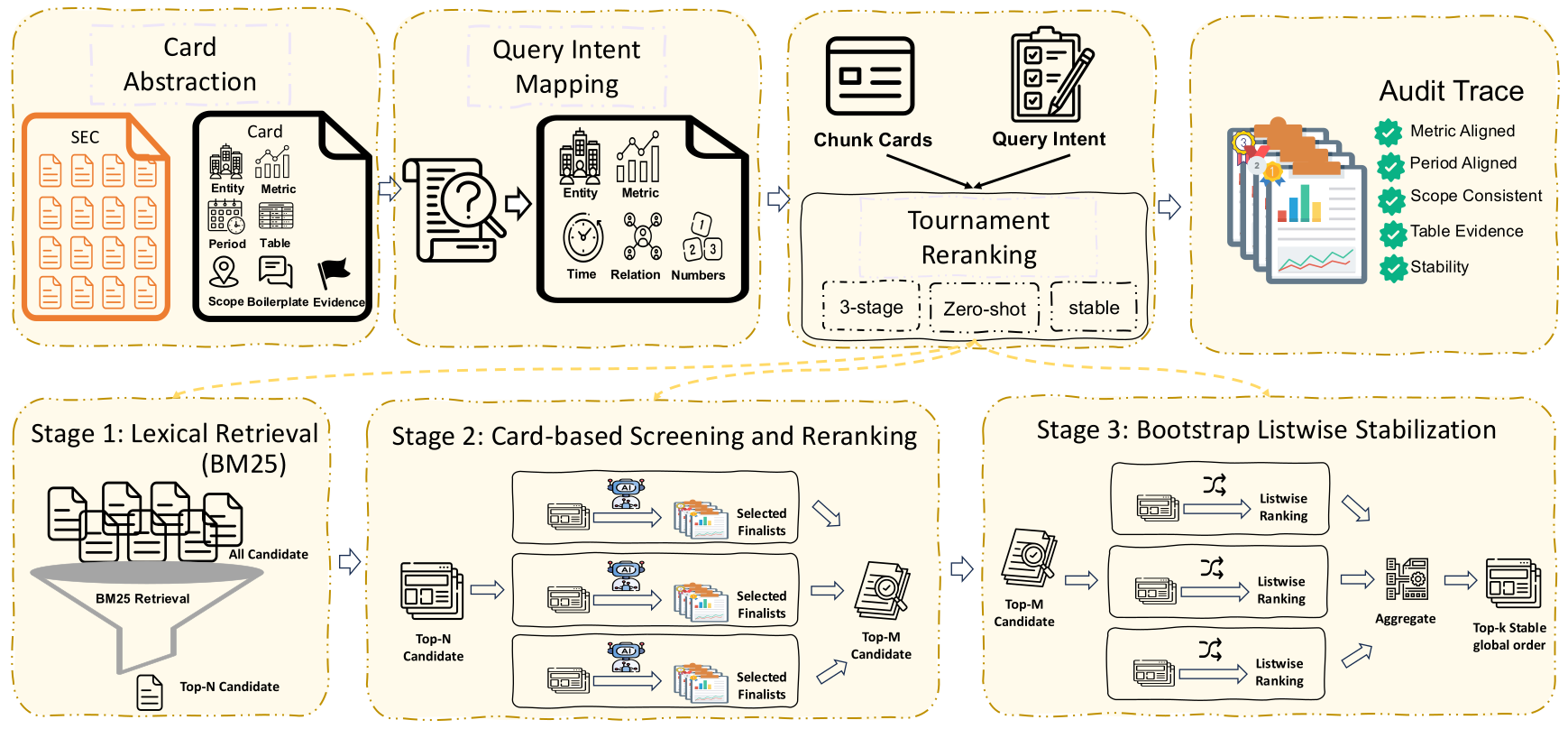
Represent each chunk by evidence role, type, temporal anchor, scope, measurement basis, verifiability, and semantic sketch.
Map questions into aligned fields for topic, entities, metrics, temporal scope, relation, and numeric evidence requirements.
Screen BM25 candidates through card-aware group comparisons and stabilize final rankings with bootstrap listwise aggregation.
FINCARDS converts long filing chunks into compact evidence cards that expose finance-specific signals such as metrics, entities, periods, numeric claims, table structure, scope, measurement basis, and evidence limitations.
Each question is mapped into the same structured space, allowing candidate evidence to be judged by explicit constraint matches rather than by topical similarity alone.
The system compares candidate evidence through card-aware tournament and listwise judgments, then aggregates the results into a stable, auditable final ranking for financial question answering.
@inproceedings{zhou-etal-2026-fincards,
    title = "{F}in{CARDS}: Card-Based Analyst Reranking for Financial Document Question Answering",
    author = "Zhou, Yixi  and
      Zhang, Fan  and
      Chen, YU  and
      Zhang, Haipeng  and
      Nakov, Preslav  and
      Xie, Zhuohan",
    editor = "Liakata, Maria  and
      Moreira, Viviane P.  and
      Zhang, Jiajun  and
      Jurgens, David",
    booktitle = "Findings of the {A}ssociation for {C}omputational {L}inguistics: {ACL} 2026",
    month = jul,
    year = "2026",
    address = "San Diego, California, United States",
    publisher = "Association for Computational Linguistics",
    url = "https://aclanthology.org/2026.findings-acl.1244/",
    pages = "24836--24852",
    ISBN = "979-8-89176-395-1"
}